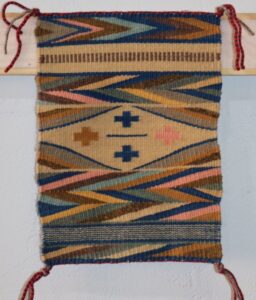
Weaving in Beauty

Explore the beauty and harmony of Navajo weaving

The Weaving News: Life in the Community of Navajo Weaving

February 1st 2010

Can High Tech Teach High Touch: Notes from an Online Weaving Class


Screenshot of the virtual classroom.


Tempe, AZ We held our first online class session in beginning Navajo weaving techniques  yesterday using WebEx’s Meeting Connection service (that’ll teach them to sell me something with unlimited minutes).   You can see the virtual class space in the picture above but it’s a screen shot of a test meeting to protect the privacy of the current students.  We found that the resolution of streaming video isn’t quite at a level that will let you see some of the finer moves that are involved in warping, but in combination with pictures, handouts and encouragement from others in the class,  we were able to create what seems to be a workable learning environment.   We’re troubleshooting an audio problem (a wicked echo) that seems to be related to speakerphones and possibly to the fact that there’s a microphone in my webcam (Who knew?  Certainly not me!)   WebEx has been great about addressing issues as we’ve brought them up and our next session is scheduled for this coming Sunday, February 7.  If you’ve written me about getting involved with a second session, I’ve got your note and I’ll be announcing dates as soon as I’m comfortable that this is a viable learning environment.  I’m almost, but not quite, there.

As one of the class members has noted, this may open up many opportunities for Navajo weavers to show their work and teach over the Internet.  And to find out about the microphone in their webcam…..

Hagoshíí (so long for now)

Mary

January 27th 2010

Southwest Indian Art Fair Rescued and Rescheduled by Tohono O’odham at Desert Diamond Casino

img_4885.jpg

Lynda Teller Pete demonstrates weaving at last year's Southwest Indian Art Fair

Tucson, AZ Just a quick post to let you know that the Desert Diamond Casino, owned by the Tohono O’odham tribe, has stepped in to reschedule and sponsor the previously cancelled Southwest Indian Art Fair.   Information on the event and artist applications are available by clicking here.  Thanks to Mary Weinzirl for letting me know!

Hagoshíí (so long for now)

Mary Walker

January 20th 2010

Some News from Morris Muskett (And He’s Having a Jewelry Sale)


Morris Muskett at left with printmaker/sculptor Melanie Yazzie (center) and exhibit developer Judy Newland (right0 at an early University of Colorado event as part of the Navajo Weaving: Diamonds, Dreams and Landscapes exhibit.


Tempe, AZ Weaver and silversmith Morris Muskett is having a 20% off sale on his jewelry at http://www.morrismuskett.com, but you’ll need to click fast because the sale ends today, January 20th.    Morris also wanted to let people know that he will be doing a talk entitled Hozho: Art by Morris Muskett on February 5th at the University of Colorado Museum in Boulder.  The talk will start at 6 PM in the Paleontology Hall and admission is free!  Morris will be discussing his weaving, jewelry and bridge art.  The event will open the last phase of the Navajo Weaving: Diamonds, Dreams and Landscapes exhibit.

Morris is also working on organizing some weaving classes in the Albuquerque area, so be sure to contact him if you’d be interested.


Hagoshíí (so long for now)

Mary Walker

January 11th 2010

A Germantown Contemporary: The Navajo Wedge Weave

img_0161

Sharie Monsam (left) and Lou Murphy (right) hold an 1880's wedge weave at John C. Hill Antique Indian Art in Scottsdale, AZ

Tempe, AZ During the 1870’s, Navajo weavers developed a new way of achieving the lightning bolt designs of their famous eye dazzlers.  Called a wedge weave, the technique involves weaving diagonal stripes which distort the vertical orientation of the warp threads, creating a scalloped edge.   My friends Liz Munk, who uses wedge weave quite a bit in her work, describes it simply as “sideways stripes”.    No one knows how Navajos happened onto the technique, which is also seen in Middle Eastern, Andean and Scandanavian  weaving, but the Navajos who used the method employed it far more extensively than others, creating whole textiles with it.    It’s possible that the weavers happened on the technique as a variation of the efficient sectional weaving method that ignorant and bigoted observers call a “lazy line”, a term that I truly detest and might write more about on a day when I feel really snarky.

The 1880’s blanket seen above alternates wedge weave sections with conventional horizontal weave, but you can still see the scallops in the wedge woven areas.   In the detail picture below, you can clearly see the bias woven wedges pulling the warp out of vertical alignment.   Thanks to John C. Hill Antique Indian Art for allow us to handle and photograph this wonderful example.

img_0162

A detail of the blanket above clearly shows the bias weave and warp distortion in the wedge weave sections.

Wedge weaves seem to have been woven by only a few people and possibly because of their irregular edges they didn’t make the transition to rugs that began in the 1890’s.  Although they’re occasionally seen in contemporary Navajo weaving, the most prominent contemporary wedge weave practitioner is Connie Lippert, who will be teaching it this July at Convergence 2010 in workshop WA207.   If you’re interested in reading more about how the weave is done, try to find a copy of Joanne Mattera’s 1975 book Navajo Techniques for Today’s Weaver (Watson-Guptil, ISBN 0823031535).  Though it’s long out of print, you will find it frequently on Ebay, from used book sellers and at many public libraries.

Although this is the conclusion of this series on Germantown, Late Classic and Transitional weaving, there is a great deal more to be seen and written about in this period.  Those of you in the Phoenix, Arizona area who are interested in this aspect of Navajo weaving can look forward to meeting author Tyrone Campbell at the Old Territorial Shop in Scottsdale, AZ from March 4-6.  He will be presenting a collection of  historic Navajo, Pueblo and Rio Grande weavings that are for sale and doing informal appraisals.    I’ll be stopping by to photograph the textiles and hopefully speak with Mr. Campbell, so look for another visit with historic weaving and weavers in March.

Hagoshíí (so long for now)

Mary Walker

Coming on Wednesday:  A Trip to the Crownpoint Rug Auction, New and Unusual Weaving

January 2nd 2010

Announcing Online Weaving in Beauty Classes in Navajo Techniques

Navajo looms

Sampler weavings produced by Weaving in Beauty students

Tempe, AZ Over the past 12 years, Jennie Slick and I have taught over 300 people how to weave the Navajo way, but not everyone who is interested can make the trip to the Southwest or get into one the workshops that we do on the road.   Starting on January 30, I’m going to try doing an online Beginning Navajo Weaving Techniques class.   Participants will need a high speed Internet connection and a headset and microphone in addition to a Navajo style loom, yarn and some tools.   A web camera is helpful, but not necessary.  Cost for this first time effort will be $30 per student to help defray the cost of the virtual classroom.   The class will be held on Sunday afternoons from 3 PM to 5PM Eastern time, 1 PM to 3PM Mountain time and will run for five weeks.  In that time, students should be able to finish a 12″x16″ sampler weaving.  I’ll schedule office hours when students can ask questions through online chat and I’ll also be available via email.   This first session will be limited to eight students.

The curriculum will include

  • warping the loom
  • mounting the warp
  • starting to weave
  • designing on the loom
  • interlock joins
  • turned joins
  • problem solving
  • finishing

We will warp the looms in the first lesson, get the looms set up and start weaving in the second session, work on interlock joins in the third session, try turned joins and diagonals in the fourth session and work on finishing in the last session.  No prior weaving experience is assumed or necessary; you just need to have an open mind and some free time.   Download access to handouts detailing the course content is included in the cost of the class.  I’ll schedule future sessions depending on the results of this class.   If you want to try accessing the virtual classroom to see you you’ll be able to participate, I’ll be glad to arrange that before or after my textile conservation work day on a first come, first served basis.

Quick update on 1/4/2010:  Right now, the class is full. There are a couple of students who aren’t sure that their Internet connections can handle it, so their seats may open up.  Please contact me if you’d like to know if and when the class will be offered again.     Upon registration, you’ll receive a list of materials needed, access to handouts and we’ll schedule a brief meeting to check out the classroom connection.

Hagoshíí (so long for now)

Mary Walker

January 1st 2010

The Brilliance of the Navajo Germantowns: Late Classic Weaving and Bayeta


img_0158

A detail of a Late Classic raveled bayeta blanket at Turkey Mountain Traders in Scottsdale, AZ.


Tempe, AZ Navajo Germantowns were woven during two overlapping periods identified as the Late Classic (1865-1880) and Transitional (1868-1895).   Both periods are marked by increasing use of commercial materials and adaptation of designs from Rio Grande, Saltillo and other weaving traditions.  During both periods, Germantown yarns were sometimes combined with other available weaving materials, most famously with raveled bayeta.   Starting in the Late Classic period, the design geometries used extended from the wider than long Chief Blanket to the longer than wide serape more closely identified with the Hispanic cultures of the region.

The Late Classic weaving shown above is at Turkey Mountain Traders and clearly shows the influence of Rio Grande and Saltillo design.  The bright red background yarns are raveled bayeta which has been respun (and possibly recarded).  The pattern yarns are Germantowns.  In the detailed photo below, I hope that you’ll be able to see the difference in the texture between the bayeta and the Germantown yarn.   You’ll also see another aspect of Navajo weaving that was introduced during this period, a knotted finish at one end of the weaving, a departure from the traditional and time consuming closed warp finish that was deemed less important since the ends were covered by an added fringe, vestiges of which can be seen here.   The downside of this technique was that it was not as durable as the traditional method, so this particular weaving is all the more remarkable because the knotted end is in good condition.  Knotted finishes were largely abandoned as Navajo textiles began to be used as floorcoverings, but they’re still used to finish the modern Gallup throws that are woven for the tourist trade.


img_0157-1

A detail of a Late Classic serape style weaving at Turkey Mountain Traders


When a gallery or museum professional is trying to authenticate or date a textile, the analysis of the materials provides crucial evidence that combined with the pattern, techniques and provenance determines the age and estimated value of the piece.  This weaving is an excellent case in point.  A visual examination shows what the background yarns are very clearly different from the plied pattern yarns, but are they Navajo-churro wool that’s been aniline dyed or are they the fabled raveled bayeta?  To definitively answer that question, we need to go into the lab and do some microscopic examination of the fibers and spectral analysis of the dye.   The shorter industrially processed wool fibers in bayeta are quite different from long staple crimpless hand-processed Churro wool and the carminic acid that produces the color in cochineal forms a distinctive fingerprint that immediately identifies the dye source.  For an interesting look at how this is done, you can check out the textile analysis pages at http://www.material-insight.com/NavajoBlanket.htm.

We have one more stop to make on our walk and we’ll be looking at a beautiful Wedge Weave from the Transitional Period at John C. Hill Antique Indian Art. Look for that installment on Sunday!

Hagoshíí (so long for now)

Mary Walker

  • Slideshow

    • Get the Flash Player to see the slideshow.
  • Quick Updates

    • I'm threading repair warps into a restoration that I'm completing this morning and getting out the rug washing brush this afternoon. #fb 2 days ago
    • More updates...

    Powered by Twitter Tools

  • Questions and Comments

  • Previous Next All
    Latest on Sun, 12:47 pm

    Celinda Hall: I live in Albuquerque, NM and I am looking for a class here in town. One school I can find is booked up. Don't want to have to take a vacation just to take a class. thanks

    michael H.: hello,I'm trying to find information on a weaver by the name of "Bissi Claws".I recently purchased a rug that was made by her in 1984. Thank You!

    Bonnie Allen: Does anyone know of any weavers in Illinois? thanks, Bonnie

    » Please add your comment or question here