A Germantown Contemporary: The Navajo Wedge Weave
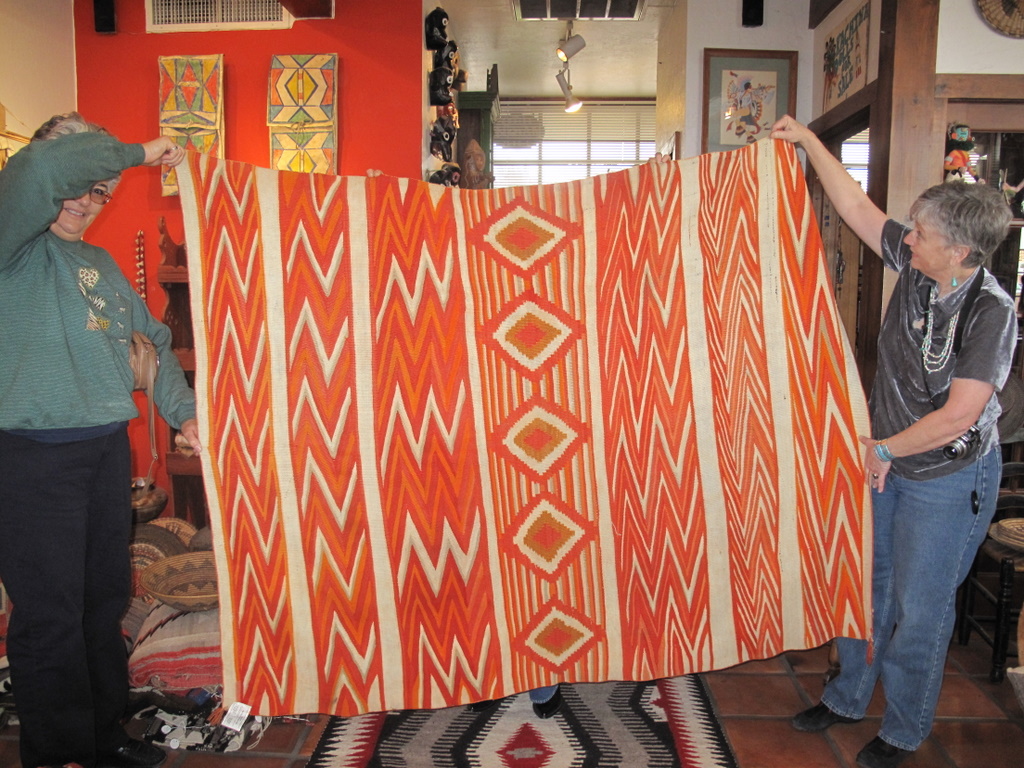
Sharie Monsam (left) and Lou Murphy (right) hold an 1880's wedge weave at John C. Hill Antique Indian Art in Scottsdale, AZ
Tempe, AZ During the 1870’s, Navajo weavers developed a new way of achieving the lightning bolt designs of their famous eye dazzlers. Called a wedge weave, the technique involves weaving diagonal stripes which distort the vertical orientation of the warp threads, creating a scalloped edge. My friends Liz Munk, who uses wedge weave quite a bit in her work, describes it simply as “sideways stripes”. No one knows how Navajos happened onto the technique, which is also seen in Middle Eastern, Andean and Scandanavian weaving, but the Navajos who used the method employed it far more extensively than others, creating whole textiles with it. It’s possible that the weavers happened on the technique as a variation of the efficient sectional weaving method that ignorant and bigoted observers call a “lazy line”, a term that I truly detest and might write more about on a day when I feel really snarky.
The 1880’s blanket seen above alternates wedge weave sections with conventional horizontal weave, but you can still see the scallops in the wedge woven areas. In the detail picture below, you can clearly see the bias woven wedges pulling the warp out of vertical alignment. Thanks to John C. Hill Antique Indian Art for allow us to handle and photograph this wonderful example.
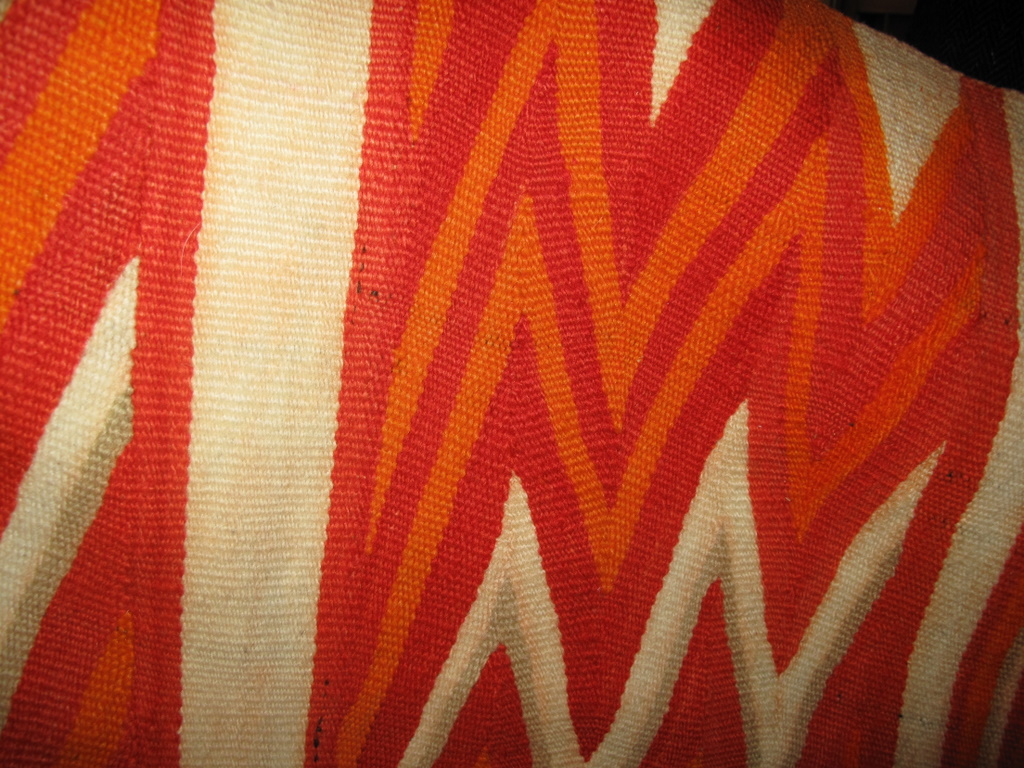
A detail of the blanket above clearly shows the bias weave and warp distortion in the wedge weave sections.
Wedge weaves seem to have been woven by only a few people and possibly because of their irregular edges they didn’t make the transition to rugs that began in the 1890’s. Although they’re occasionally seen in contemporary Navajo weaving, the most prominent contemporary wedge weave practitioner is Connie Lippert, who will be teaching it this July at Convergence 2010 in workshop WA207. If you’re interested in reading more about how the weave is done, try to find a copy of Joanne Mattera’s 1975 book Navajo Techniques for Today’s Weaver (Watson-Guptil, ISBN 0823031535). Though it’s long out of print, you will find it frequently on Ebay, from used book sellers and at many public libraries.
Although this is the conclusion of this series on Germantown, Late Classic and Transitional weaving, there is a great deal more to be seen and written about in this period. Those of you in the Phoenix, Arizona area who are interested in this aspect of Navajo weaving can look forward to meeting author Tyrone Campbell at the Old Territorial Shop in Scottsdale, AZ from March 4-6. He will be presenting a collection of historic Navajo, Pueblo and Rio Grande weavings that are for sale and doing informal appraisals. I’ll be stopping by to photograph the textiles and hopefully speak with Mr. Campbell, so look for another visit with historic weaving and weavers in March.
Hagoshíí (so long for now)
Mary Walker
Coming on Wednesday: A Trip to the Crownpoint Rug Auction, New and Unusual Weaving

Thanks for the kind words, Morris!
Mary,
I love your posts on Germantown pieces especially your statement about “lazy lines”. Thanks for your posts and updates for upcoming events.
Morris