Weaving in Beauty

The Best and the Brightest (Natural Dyes, That Is)
20th April 2010

The Best and the Brightest (Natural Dyes, That Is)

img_1040

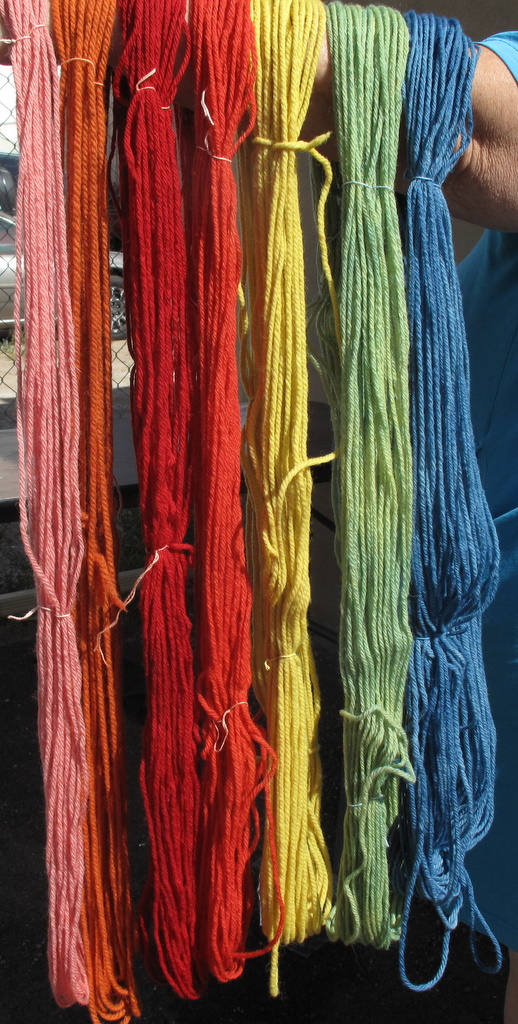
From left, exhaust cochineal, madder, first bath cochineal, osage orange, indigo over osage orange and indigo.

Mesa, AZ It’s April and the thermometer in the Valley of the Sun is in the 90 degree range.   It’s indigo weather!   Add some cochineal bugs, munjeet (a type of madder) and osage orange sawdust and you’ve got a rainbow in the making.   Cochineal and indigo color some of the yarns used by Navajo weavers in the 19th century and some of fine artists among Navajo weavers, like D.Y. Begay, Roy Kady and Morris Muskett continue to work with them as well as some of the other dyes that I taught students how to use yesterday and last Saturday at the Fiber Factory in Mesa, AZ.

Working with these dyes helps you to develop a profound appreciation for both history and chemistry.  The sources of these colors span the globe and they are integral players in the flow of events from the earliest times.  There are textiles found in Egypt dyed with madder, the Aztecs exacted tribute in cochineal and the Scots dyed their faces blue for battle with woad, an indigo bearing plant.   These are colors of the finest of the Chief Blankets, the Late Classic Blankets, the British red coats and Bayeux Tapestry.  By manipulating the properties of their vats and baths, dye masters developed proprietary formulas and methods that were guarded every bit as closely as the design of the next iPhone.    It’s a real privilege to be able to teach their use and legacy to others.   I have to go rinse some yarn…..

Hagoshíí (so long for now)

Mary Walker

Weaving in Beauty LLC
1868 E. LaDonna Dr. TempeAZ85283 USA 
 • 602-370-2875
This entry was posted on Tuesday, April 20th, 2010 at 10:24 am and is filed under Native and Non-native Dyes. You can follow any responses to this entry through the RSS 2.0 feed. Both comments and pings are currently closed.

There are currently 2 responses to “The Best and the Brightest (Natural Dyes, That Is)”

Why not let us know what you think by adding your own comment! Your opinion is as valid as anyone elses, so come on... let us know what you think.

  1. 1 On April 20th, 2010, Sandy Gally said:

    Beautiful!

  2. 2 On April 20th, 2010, Mary Walker said:

    Thanks, Sandy! We really hit the mother lode on that cochineal yesterday. Have dye pots, will travel….

  • Connect with Weaving in Beauty

    <<May 2012>>
    SMTWTFS
    29 30 1 2 3 4 5
    6 7 8 9 10 11 12
    13 14 15 16 17 18 19
    20 21 22 23 24 25 26
    27 28 29 30 31 1 2
  • Slideshow

  • Get the Flash Player to see the slideshow.
  • Questions and Comments

  • Previous Next All
    Latest on Mon, 04:10 pm

    Raymon: I have a blanket simialr to the pink blanket. My dad's family had sheep. Every year they would gather the wool and take it to Utah Woolen mills and make beautiful wool blankets. Similar to Pendleton blankets, in many different colors. Love the turquoise jewlrey. My mom has a big beaded bag of it that I hope I get a few peices of (she's half Native American) She finds it kind of amusing that Native American prints etc. are "in" right now.

    Remigio: Way to go, Navajo Nation! Either cease-and-desist, or collect roiaetyls for the use of your name (only on quality products of which you approve, of course). Same with sports teams that use Native names as mascots. Until recently, the University of North Dakota was paying the Standing Rock Sioux annual roiaetyls to use the name Fighting Sioux , which was a win-win and a source of pride for both parties. Unfortunately for both the Tribe and the university, political correctness put an end to that.

    Ann Puzio: Hi Mary, Need to change to the waiting list for 9/13-20th. I hope this is possible.Also, going to see if I can sign up for the online class, need to check my computer. Thanks ann

    » Please add your comment or question here