Weaving in Beauty

An Early Ye’i Bi Chei Weaving
30th July 2008

An Early Ye’i Bi Chei Weaving

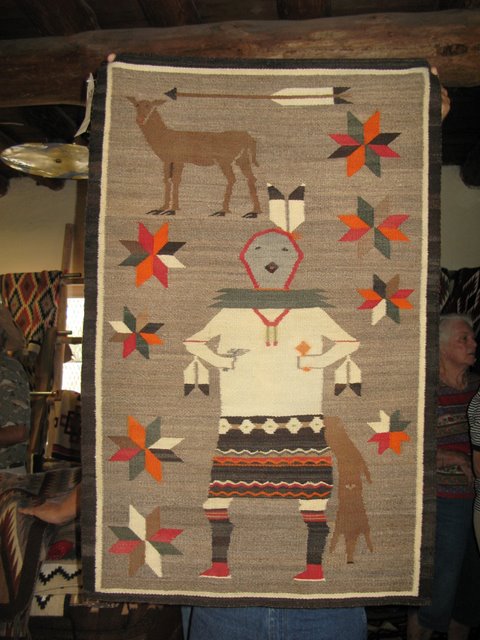
A Yei Be Chai weaving dating to the early 1900\'s

The handsome weaving above was offered at the Smoki Museum Navajo rug auction last weekend.  It’s the earliest depiction of a Ye’i Bi Chei dancer that I’ve seen and I thought you might enjoy a look at it too.  It dates to the late 1890′s or early 1900′s and is done in the style of a weaver named Yanapah Simpson.  Yanapah was married to a trader and lived in Farmington, New Mexico, but traders in Lukachukai, Arizona and Shiprock, New Mexico were also known to have encouraged the weaving of figural rugs during this period.  The dancer is surrounded by Valero stars, an influence from Rio Grande weaing, and a very lifelike deer.  The weaving skill in this piece is phenomenal, with crisp, straight lines and sides and wonderful detailing in the kilt and deer figure.

These pieces were quite controversial at the time with many Navajo people believing that depictions of deities and ceremonies should be off limits as weaving subjects, particularly when they were offered for sale.  This belief still persists among many weavers and those who weave Ye’i and Sandpainting rugs often have ceremonies done to protect them from any ill effects.  On the other hand, I’ve also heard at least one weaver downplay the potential for trouble, saying “I’m a Presbyterian, so I don’t believe it’s a problem”.  For most Navajo people, however, these figures remain very powerful and a recent exhibit of Sandpainting rugs carried a warning that traditional Navajos might find the display offensive.

The Ye’i Bi Chei are also called Winter Gods and Grandfather Spirits (which is what the name means in Navajo) and are the focus of healing ceremonies held in the Fall and early Winter.  During these ceremonies, the dancers take on the role of intermediaries between the gods and the human race.  The ceremony continues over the course of several days, with some portions open to the public.  The most accessible of these is held in early October at the Shiprock Fair.

Weaving in Beauty LLC
1868 E. LaDonna Dr. TempeAZ85283 USA 
 • 602-370-2875
This entry was posted on Wednesday, July 30th, 2008 at 8:24 am and is filed under It's All About the Rugs, Sold! Auction Notes. You can follow any responses to this entry through the RSS 2.0 feed. Both comments and pings are currently closed.

This page is closed to comments. Please contact us if you have a question on this page.

  • Connect with Weaving in Beauty

    <<May 2012>>
    SMTWTFS
    29 30 1 2 3 4 5
    6 7 8 9 10 11 12
    13 14 15 16 17 18 19
    20 21 22 23 24 25 26
    27 28 29 30 31 1 2
  • Slideshow

  • Get the Flash Player to see the slideshow.
  • Questions and Comments

  • Previous Next All
    Latest on Mon, 04:10 pm

    Raymon: I have a blanket simialr to the pink blanket. My dad's family had sheep. Every year they would gather the wool and take it to Utah Woolen mills and make beautiful wool blankets. Similar to Pendleton blankets, in many different colors. Love the turquoise jewlrey. My mom has a big beaded bag of it that I hope I get a few peices of (she's half Native American) She finds it kind of amusing that Native American prints etc. are "in" right now.

    Remigio: Way to go, Navajo Nation! Either cease-and-desist, or collect roiaetyls for the use of your name (only on quality products of which you approve, of course). Same with sports teams that use Native names as mascots. Until recently, the University of North Dakota was paying the Standing Rock Sioux annual roiaetyls to use the name Fighting Sioux , which was a win-win and a source of pride for both parties. Unfortunately for both the Tribe and the university, political correctness put an end to that.

    Ann Puzio: Hi Mary, Need to change to the waiting list for 9/13-20th. I hope this is possible.Also, going to see if I can sign up for the online class, need to check my computer. Thanks ann

    » Please add your comment or question here