Weaving in Beauty

Weaving in Beauty October Class: Two Grey Hills and Toadlena

The Weaving News: Life in the Community of Navajo Weaving

October 9th 2008

Weaving in Beauty October Class: Two Grey Hills and Toadlena

Today, our Window Rock class took a field trip to Two Grey Hills and Toadlena.  These areas are noted for finely woven rugs woven in natural colors.  There are two trading posts in this area, so we had a busy afternoon.  We stopped at first at the Toadlena Trading Post and Rug Museum to visit with Mark Winter.  Mark took the class through the Master Weavers exhibit showing the development of the Two Grey Hills style through the years.  Mark made the interesting observation that it was in the Two Grey Hills area that rug weavers were first identified with their work.  Mark graciously allowed us to examine a Daisy Tauglechee rug while we were in the museum.  You can see Mark with the students in the picture below.

Mark Winter of the Toadlena Trading Post and Rug Museum shows the students through the Master Weavers exhibit.

Mark Winter of the Toadlena Trading Post and Rug Museum shows the students through the Master Weavers exhibit.

One of the more interesting rugs at Toadlena is pictorial of an Indian chief in full regalia.  Mark had seen a picture of the rug, and it turned up in show within the next two weeks.  As you can see in the picture of part of the rug below, it’s very distinctive.

We went on to the Two Grey Hills Trading Post where Shirley Brown showed us one of her fabulous hand carded and handspun rugs.  It is approximately 4′x6′ and is priced at $9000.  Here’s a picture of Shirley with the rug in the Two Grey Hills rug room.

Shirley Brown with her handspun and handcarded Two Grey Hills rug.

Shirley Brown with her handspun and handcarded Two Grey Hills rug.

Before we left Two Grey Hills, Shirley took us out to see Irma Henderson’s Navajo-Churro sheep.  I took the opportunity to take a picture of my favorite Navajo-Churro ram and I’ll call it a day with that picture.

Irma Henderson's Navajo-Churro ram.

Irma Henderson's Navajo-Churro ram.

October 6th 2008

Weaving in Beauty October Class: Burnham’s Trading Post and Richardson’s

Our class is making great progress on their weaving and today we made our way to R.B. Burnham and Company Trading Post in Sanders, Arizona and then went on the Gallup, New Mexico for a visit to Richardson’s Trading, which is home to the world’s largest Navajo rug room.

At Burnham’s, we enjoyed talking about rug designs and various types of wool that have been used in Navajo weaving.  That lead us into a discussion of the importance of sheep in traditional Navajo life and Virginia Burnham told us about her experiences in caring for her family’s sheep as a very young child.

Virginia Burnham talks about the role of sheep in Navajo culture with Gloria Thompson (left) and Rosemary Morrill (right) as Bruce Burnham looks on.

Virginia Burnham talks about the role of sheep in Navajo culture with Gloria Thompson (left) and Rosemary Morrill (right) as Bruce Burnham looks on.

A visit with Bruce and Virgina is always interesting and we also enjoyed spending some time in their wool room.  Before we left, we took a group picture with Bruce and Virginia that you can see below.

From left, Mary Falzone, Jan Souders

From left, Mary Falzone, Jan Souders, Ann Enyart, Nance Howsman, Cheryl Griffin, Diane Craig, Gloria Thompson, Thomas Griffin, Rosemary Morrill, Bruce Burnham, Virginia Burnham at R.B. Burnham and Co. in Sanders, AZ.

Next we went to Jennie Slick’s home and she showed the class how large floor rugs are woven, demonstrating with a large Burntwater rug that she is working on for a client.   She hopes to finish it by the end of the year.

Jennie Slick weaves as Thomas Griffin looks on.

Jennie Slick weaves as Thomas Griffin looks on.

Our final stop for the day was at Richardson Trading in Gallup, New Mexico.  There we were allowed the privilege of exploring the world’s largest Navajo rug room on our own, and we even got Thomas to model a First Phase Chief Blanket dyed with cochineal and indigo.

Thomas models a First Phase Chief Blanket at Richardson's Trading Company in Gallup, NM.

Thomas models a First Phase Chief Blanket at Richardson's Trading in Gallup.

October 1st 2008

Mark Winter at the Southwest Traders Rendezvous

I hope you’ll enjoy hearing Mark Winter talk about a recent trading experience that he had with 94 year old weaver Clara Sherman.  Mark was at the the recent Southwest Traders Rendezvous in Cortez, Colorado and was participating in the show and tell portion of the program when he told this story on September 27, 2008.  Mark wasn’t using a microphone and turned away from the camera, so a few of his words get lost as he’s talking, but I think you can get the gist of the story, which is about three minutes long.

Get the Flash Player to see the wordTube Media Player.

Mary Walker

September 29th 2008

Southwest Trader Rendezvous

Cortez, CO I came straight to Cortez when Jennie Slick and I returned from our Boston workshop to attend the Southwest Traders Rendezvous. This event is sponsored by the Cortez Cultural Center and provides a venue for traders to discuss their stories and the past, present and future of the trading business.  As you might imagine, there were some great stories and I’ll post some of those in the next few days.  I need to get back to Phoenix, but I thought I’d post a couple of quick pictures while I’m having a second cup of coffee here in Cortez.

The picture below is a group photo of many of the traders and their families.  I’ll try to identify the people that I know and I’ll fill in the details on the others as I get them.  First row from left, Camy Begay, Kira Simpson, Grange Simpson, Georgia Kennedy Simpson, John W. Simpson, Minnie Malone, Bill Malone, Steve Getzweiller.  Second row from left: Clarenda Begay, Steve Simpson, John D. Kennedy, Claudia Blair, Mrs. Steve Hassler, unidentified, unidentified, Virginia Burnham.  Third row from left: Harold Burnham, Jim Blair, Vonda Blair Garland, Elijah Blair, Larry Tanner, Hank Blair, Larry Tanner, unknown, Bruce Burnham, Jeff Burnham.  Fouth row from left: unidentified, Joe Tanner, undentified, Steve Hassler, Mark Winter, Jackson Clarke II.

Yesterday, the Rendezvous concluded with a rug auction and I purchased a piece by 17 year old weaver Cheyenne Flatrock.  Cheyenne has combined some traditional elements in a fresh and contemporary way that I really like.  Here she is with the rug.

Cheyenne Flatrock with her contemporary weaving.  That's an 1880's blanket in the background.

Cheyenne Flatrock with her contemporary weaving. That's an 1880's blanket in the background.

September 17th 2008

The Navajos and The Amazing Cochineal Beetle, Part I

Jennie Slick and I are in Albuquerque on our way to do a three day workshop in Massachusetts.  Just before I left Phoenix, I washed and rinsed some custom yarns for the students to look at.  One group of them was dyed with cochineal.  There’s a picture of the grouping below.  Isn’t it amazing that one dyestuff can yield this many colors?   These are only a few of the results that you can get with these amazing critters, who are just stuffed with carminic acid.

Clockwise from lower left, high concentration dyebath with cream of tartar, late dyebath with tin mordant, ammonia afterbath, high percentage tin mordant

All cochineal! Clockwise from lower left, high concentration dyebath with cream of tartar, late dyebath with tin mordant, ammonia afterbath, high percentage tin mordant

Many authorities say that the Navajos didn’t dye with cochineal; that they only used raveled threads, sometimes recarding them.  Others, such as Kate Peck Kent and Joe Ben Wheat thought that they could identify Navajo handspun that had been dyed with cochineal.  I’m interested in following up on this to see if there’s a definitive answer, and I’ll fill you in on my results.

September 11th 2008

Designing on the Edge: Exploring the Design Limits of Navajo Weaving

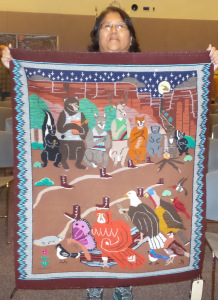
I really enjoy seeing weaving that pushes out the boundaries of design and helps to extend the audience of Navajo weaving.  One of the weavers who does this consistently is Mae Clark of the New Lands area near Sanders, AZ.  Mae’s work is seen exclusively at R.B. Burnham and Comany and I have the privilege of photographing it for the Burnham’s website.  I thought you might enjoy seening two of the tapestries that Mae did earlier this year, and which are already sold.  The rug below was inspired by the rainbirds of Pueblo pottery and Mae dyed the Germantown yarns herself to get the shading that she wanted.

This Mae Clark weaving was inpired by Pueblo pottery.

This Mae Clark weaving was inpired by Pueblo pottery.

Mae also completed another cutting edge weaving in March.  It was truly arresting to see it in the Burnham’s gallery.  You had to focus on the weaving to get the full impact of the design and not everyone liked it.  In fact, a couple of people called it “The Lips”.   The hooded figure represents a bereaved mother and the hummingbird represents a deceased child who has returned to say, in Mae’s words, “You made me what I am; I’ll be alright”.  Although I had no intention of writing about 9/11, it’s an appropriate weaving and thought for the day.

Mae Clark's weaving represents the spirit of a deceased child comforting its mother.

This weaving by Mae Clark represents the spirit of a departed child comforting its mother.

  • Get the Flash Player to see the slideshow.
  • Weaving News Archives