Weaving in Beauty

Rug of the Day: Two-Sided Burntwater by Lola Cody

The Weaving News: Life in the Community of Navajo Weaving

April 29th 2011

Rug of the Day: Two-Sided Burntwater by Lola Cody

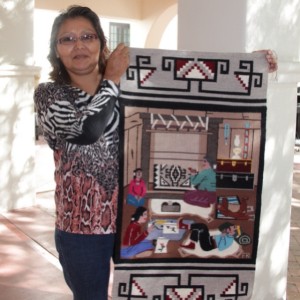
Burntwater double weave by Lola Cody

Nothing up her sleeves and her hands never left her wrists! Lola Cody set up her loom to do a double weave.

Tempe, AZ Lola Cody is noted for her weaving in general, but is particularly famous for her work with weft-faced double weave, which when combined with other Navajo techniques produces a weaving with two sides.   In a conventional Navajo weaving, there are two paths or “sheds” for the weft threads to follow.  A two-sided piece uses four sheds which have to be manipulated in the correct order to produce the two sided effect.  There is a diagram of the tie-up in Designing with the Wool by Noel Bennett and Tiana Bighorse, and I warp my loom so that I have one less warp thread per side than I would normally use with the weft that I’ve chosen, but you could use any number of warps per side as long as it is at least one lower than you’d usually use.  For instance, with Burnham’s #1 Trading Post Yarn, I’d warp my loom at 14 ends per inch, using 7 on each side.  I found this number by trial and error and I like it because it minimizes the thickness of the double weave, but the wefts don’t peak through from the other side.

The weaving process is a simple progression in which the first shed and third sheds are manipulated to weave the side facing the weaver and the second shed  and fourth sheds produce the side that is away from the weaver.  While it is possible to do a pattern on both sides, it requires a lot of peeking around or a mirror and Lola opted for a stripe pattern on the other side.  Some weavers combine the two sides tie up with a twill tie up to produce a weaving with twill borders and design panels.  One of these days I’ll run across a picture of one of them.

Double sided rugs go back into the nineteenth century Transition period.  One of the largest ever woven is the 18′ x 12′ (that’s right) Staples rug which is now in the collection of the Museum of Northern Arizona.   You can read a scholarly paper on the rug by historian Bob Ring on his web site.    Two-faced weaving is not very common today and Lola generally charges around $5000 to do one.   I have seen some at the Crownpoint Rug Auction and R.B. Burnham and Co. Auctions in the $700 to $1100 price range.

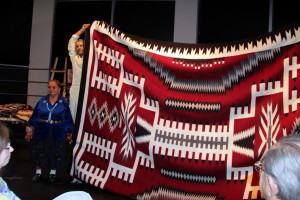
Lola used vegetally dyed Burnham’s Trading Post Yarn in size 1 for this weaving, which was photographed November 6th, 2011 at the Heard Museum Gathering of Weavers in Phoenix, AZ using a Canon Powershot G10 camera.  The Gathering is usually held on the first Saturday in November.  You can click on either picture below for a close-up of both sides of the rug.

Lola Cody Double Weave side 1 Lola Cody Double Weave side 2

Hag0shíí (so long for now)

Mary Walker

Weaving in Beauty LLC
1868 E. LaDonna Dr. TempeAZ85283 USA 
 • 602-370-2875
posted in Rug Of The Day | Comments Off
March 7th 2011

2011 Heard Museum Indian Market, A Walk in the Sunshine: Part I

Melissa Cody with Germantown weaving

Melissa Cody with her colorful contemporary Germantown design

Marilou and Martha Schultz

Marilou Schultz spins under the watchful eye of her mother, Martha Schultz

The Ornelas Family

From left, the tapestry weaving family of Michael Ornelas, Barbara Teller Ornelas and Sierra Ornelas

Click on any picture for a closer view

Phoenix, AZ The Phoenix Chamber of Commerce cranked up some of the best weather in memory for the 52nd Heard Museum Indian Market, which concluded yesterday.   It was warm, but not too warm, there were breezes but it was not windy and it was blessedly free of rain.  As you might expect, by afternoon the crowds were getting thick.  By arriving when the gates opened, I was able to get time to chat with many of the weavers there before other shoppers arrived.

The Market tends to put artists in similar locations each year, which helps to locate people without depending too much on the brochure.  Morris Muskett’s booth was my first stop and he had a selection of jewelry and small weavings that were very, very tempting.  Photographs of Morris work are shown exclusively on his web site, so be sure to visit him to see what he’s been working on.  Just don’t get too fond of that red spiny oyster pendant because I have my eye on it.

D.Y. Begay shared a booth with her twin sisters, Berdine Begay and Berdina Charley.  Each has a distinctive style that is eye catching and contemporary.  D.Y. uses her own vegetally dyed yarns for her work.  Her dye materials range from plants native to the Southwest to black beans from WalMart.  D.Y. has been traveling extensively in Central and South America and is trying to get the time to organize her pictures and other materials from her journeys.  You can see Berdine, Berdina, D.Y. and their work in the gallery below.

Marilou Schultz and her mother Martha were in the booth next to D.Y. and her sisters, so that was an easy stroll.  Marilou is not one to sit in a booth without doing something and she was busy spinning as her mom looked on (center picture above).  Marilou had a great assortment of handspun rugs and her variegated yarns.  You can also see more of Marilou’s work at her website and in the picture gallery below.

Last year, rain prevented me from getting a clear picture of Melissa Cody’s contemporary version of the Germantown Eyedazzler.  This year, she graciously posed with one of her smaller pieces as you’ll see at the upper left.  Melissa does a kind of blocking of the somewhat fluffy Germantown yarns that she uses by winding them into tight balls that she keeps under tension for up to a year before she uses them.   She had sold a larger piece that was more complex than the one that she is posing with.  Melissa is part of the growing group of younger weavers who pursue their weaving as fine artists while maintaining a full time career in other fields, in Melissa’s case in the allied field of museum curation.

Sierra Ornelas, Barbara Teller Ornelas‘ daughter is also part of this two career trend, living in Los Angeles and working as a writer for a television show.  Brother Michael, however,  is weaving full time and doing detailed framed small pieces.  Almost every weaver that I stopped to talk with had small “recession rugs” that reflect the effect of the economy and the determination of the weavers to adapt to it.  The Ornelas’ reported that they’d had a very good market and had very few pieces left on Sunday morning.

Leaving the Ornelas family, I stopped by Linda Taylor’s booth and she had some time to chat about her detailed tapestry work as well as her work as an illustrator.  Linda did the drawings for the book Wisdom Weaver by Jann Johnson.  The story details the process of weaving a Navajo rug and the love between a young girl and her grandmother.  The tale is told both in English and Navajo and is published by Salina Bookshelf, which specializes in books for the Navajo market.  You can see Linda with the book in the gallery below.

I went on to visit with Geneva Shabi, Brenda Spencer, TahNiibaa Naataanii, Phil Singer, Gilbert Begay, and Jason Harvey and I’ll write more about my visits with them on Wednesday.  I’ll leave you with the full gallery of the weavers and their work and we’ll have more of an in depth visit with each of them in  part two of this article.

[SFBSB button="button" style="padding-right:4px;padding-bottom:4px;"]
November 12th 2009

2009 Gathering of Weavers Conclusion

Sylvia Begaye works on miniature rugs that become part of the clothing worn by her dolls.

Phoenix, AZ I wish I could include a picture of each of the weavers at this year’s event, but I just couldn’t visit with everyone and still attend the afternoon lectures that I wanted to go to.  I did get a chance to talk with Sylvia Begaye, a noted dollmaker who incorporates hand woven textiles into the clothing worn by her creations.  In the picture above, you can see that two of the dolls are wearing Chief Blankets and the seated weaver doll is wearing a handwoven sash belt.  Sylvia lives in Ft. Defiance, AZ and frequently takes her dolls to the Crownpoint Rug Auction.  You won’t find Sylvia’s work in the auction itself; she sells the dolls in the hallway outside the gym where the auction is held.

Monica Glasses and her daughter with some of Monica's work in center and at right. A rug by Monica's mother, Nellie is at left.

Nellie Glasses, who is one of my favorite weavers, wasn’t able to make the trip to the Heard from Rough Rock, AZ, but her daughter Monica Glasses was there with her daughter, aged 7.  Monica’s daughter was non-committal when asked if she was going to learn to weave, but she was clearly proud of the work that her mother and grandmother do.  One of Nellie’s handspun and handcarded pieces is at left in the picture above and Monica wove the Ganado Red in the center and the Chinle design at right.  I hope to see Monica at the Pueblo Grande  Auction later this month.

IMG_3019

Jackson Clarke of the Toh Atin Gallery in Durango, CO discusses the development of design in Navajo weaving.

After a delicious lunch in the Heard cafe, it was time for a talk on rugs by Jackson Clarke of Toh Atin Gallery in Durango, CO.   Jackson discussed the development of design in Navajo weaving and showed many examples.  The Transitional Eyedazzler that he ‘s holding in the picture above is woven with Germantown yarns and dates into the 1880′s, a time when weavers were, with one of two exceptions, anonymous.  Rugs, even when they won prizes, were associated with a trader rather than a weaver, a practice that lasted into the 1930′s.  As time has gone on, weavers have increasingly differentiated their work and developed artist centered markets for it as collectors seek out pieces by D.Y. Begay, Roy Kady or Morris Muskett.   Jackson used Helen Begay’s work as an example.  Helen and her family, building on a multi-generational weaving tradition have devekoped a distinctive pictorial  style called a Burnham rug.  You can see one of Helen’s rugs, titled “Cruising the Rez in My Ford Truck”, in the picture below.  As much as any painting of piece of sculpture, this is a carefully composed, titled and realized work of art.   And the wool is mostly hand spun.

IMG_3052

Helen Begay's "Cruising the Rez in My Ford Truck"

Mark Winter of Toadlena Trading Post followed Jackson’s talk with a discussion of his work in the Two Grey Hills area of New Mexico.  Mark has been very successful in documenting not only the development of weaving patterns and techniques but the weavers and their lives and families.  His book on the subject, a culmination of 20 years of research, will be published in May of 2010 in time for an exhibition on Two Grey Hills weaving at the Wheelright Museum in Santa Fe.  Mark never, ever does anything halfway and I’m definitely going to add his book to my library when it’s published.  In true Mark fashion, he had a 130 weft count Daisy Taugelchee tapestry with him and graciously walked the piece around so that every audience member who wanted to could touch and appreciate Daisy’s work up close.  Mark also talked about the development of design and artistry and display and striking pictorial piece by Pamela Brown depicting sisters united under the sun and moon, even when they are separated by great distances.

Mark Winter holds Pamela Brown's pictorial weaving.

I had hoped that I’d have time to visit with some more of the weavers, but Mark’s talk went over the time limit and was so fascinating that no one noticed.  When I left the auditorium, the museum staff was cleaning up the courtyard and I was vowing that next year I’d get to more of the weavers, especially the new ones.  The Heard has scheduled next year’s Gathing of Weavers for Saturday, November 6.   I’ll see you there!

Hagoshíí (so long for now)

Mary Walker


November 9th 2009

2009 Gathering of Weavers Continued

D.Y. Begay demonstrates natural dyes Navajo style. The wool she's holding is dyed with Navajo tea.

Phoenix, AZ Moving down the Heard Museum’s courtyard at the Gathering of Weavers last Saturday, I smelled Navajo tea and then saw D.Y. Begay with her dyepots.  Also called kota or greenthread, the Navajo tea plant is used to make a beverage as well as a dye for wool.  Depending on the type of pot used, the mordant applied and the amount of time that the wool is processed, the plant yields colors ranging from gold to burnt orange.  D.Y. was also processing some brazilwood and walnut hulls.  Weavers who do their own dyes are always exploring the color potential of various plants.  At a lecture that I attended on Saturday afternoon, Jackson Clarke told the audience about arranging to have Ella Rose Perry, a master weaver and dyer, do a demonstration for an event in Utah.  Grandma Perry was way overdue and when she arrived she explained to a worried Jackson that she’d been stopping at various elevations to collect plants that she just could not get at home!   A picture of a section of  one of Grandma Perry’s rugs appears below. The gold color in this rug is Navajo tea.  Look at how skillfully Ella Rose has used the Crystal weave in the striped areas of this rug.

IMG_3065

A section of a Crystal Rug by Ella Rose Perry

Right behind D.Y.’s dye demonstration, Lola Cody was doing a warp the Navajo way.   If you look carefully at the picture below, you’ll see that she’s using her loom as a warping frame and that she’s ensuring that she her warp dimensions are even by using pipes rather than dowels.  What you can’t see as easily is that the warp is (now sit down) hand spun Navajo-churro wool. Fellow weavers, I am here to tell you that this warp was absolutely beautiful.  That warp was so strong and evenly spun.   Lola let me hold the ball  in my hand and I knew that the courtyard was too crowded for me to make a clean getaway, plus there were a bunch of people there who knew me and I want to stay friends with Lola.  I handed the warp back to her.  Yep, I’m going to try spinning my own warp.

Lola Cody demonstrates warping the traditional Navajo way with handspun Navajo-churro warp.

Barbara Jean Teller Ornelas was working on a matched set of four tapestry grade miniature Chief Blankets.  When it’s complete, the set will include two First Phase patterns, a second phase and a Third Phase.

Barbara Jean Teller Ornelas works on her set of four Chief Blanket miniatures.

You’ll want to see Barbara’s work and her loom set up in the picture below.  You’ll see that the First Phase blanket pattern (left) is composed of stripes and the Second Phase adds nine carefully placed blocks that would line up when worn.  The Third Phase piece will have diamond design elements in place of the blocks.  These small pieces will have about 100 weft threads to the inch.

IMG_3002We’ve worked our way down one side of the courtyard, but there are some new weavers for us to meet tomorrow and you’ll also be interested in some of the rugs that Jackson Clarke and Mark Winter discussed in their talks on Saturday afternoon.   Look for that update on Wednesday; I’m helping with a weaving class tomorrow weaving.  If you’re near the Fiber Factory in Mesa, AZ, stop by and say hello.

Hagoshíí (so long for now)

Mary Walker

posted in It's All About the Rugs | Comments Off
November 8th 2009

2009 Gathering of Weavers at the Heard Museum

The 2009 Gathering of Weavers attracted a large group of weaving enthusiasts. The 86 degree ideal weather didn't hurt either.

Phoenix, AZ The Heard Museum held their second annual Gathering of Weavers yesterday.  It’s a one day event dedicated to weaving and weavers held on the first Saturday in November.   The event is held outdoors in the museum’s courtyard and allows buyers to purchase rugs directly from the weaver.  The museum handles the sales through their shop, allowing the weavers to take credit cards, something that most of them do not do.   I can’t remember exactly what percentage the weaver receives, but I believe it is 80% or more and there was no charge for table space, a big help for the weavers.   Weavers at the event included well known names like Brenda Spencer, Lola Cody, D.Y. Begay and Barbara Jean Teller Ornelas, but newer and weavers who have not had as much public exposure like Monica Glasses, Nathan Harry and Loretta Tahe were also there.   I’ve culled a few pictures from my embarrassingly large assortment so that you can get an idea of the artists and their work.

Loretta Tahe shows her feather rug design.

Loretta Tahe of Hardrock, AZ weaves this distinctive pattern that she calls a Feather Rug.  Each feather has a different design.  Loretta usually sells her work at the Crownpoint Rug Auction and generally weaves one rug each month.   A detail of the expertly woven center feather area is below.

Here's a detail of ther center five feathers in Loretta's rug.

Gilbert Begay wears his handwoven vest.

Gilbert Begay of Crownpoint, NM is a familiar person to many of you who have visited the site before.  Gilbert is a prolific and creative weaver who often stops by when Jennie Slick and I are doing classes in Window Rock.  Although he works full time for Safeway in Farmington, NM, Gilbert spends a lot of his spare time weaving small format rugs and specialty bags like the one seen below.  The wool used in the bag is some that Gilbert and I dyed during our annual Cochineal Cookoff  in Window Rock this August.  Gilbert had used the yarn for the bag below and a small mat.  I purchased one of Gilbert’s bags at a recent auction and will be putting it in the Mercantile later today or in the morning.

One of Gilbert Begay's small bags. The wool in this weaving is dyed with cochineal.

Brenda Spencer shows her latest Wide Ruins design

Brenda Spencer of Dallas, TX and her sister Geneva Shabi of Sanders, AZ were just across the aisle from Gilbert.  Brenda has incorporated a unique wave pattern that is occasionally seen in very old textiles and that we’ve been working on duplicating for the last four years or so.   Brenda has incorporated this element masterfully into the Wide Ruins design that you see above and in a detail below.  The technique is an optical illusion of a curvilinear pattern created by careful manipulation of diagonal lines and weft counts.

Here's a detal of the wave design in Brenda Spencer's Wide Ruins rug.

Geneva Shabi with one of her prize-winning Wide Ruins rugs.

Geneva Shabi, Brenda’s sister also had rugs displaying her dazzling mastery of the Wide Ruins design idiom.  Geneva works for as a relief postmaster when she’s not weaving.  Although you can see that Brenda and Geneva share some influences in their work, Geneva’s take on the Wide Ruins design is very much her own.  You can see a detail from the striped section of her smaller weaving in the picture below.   Look at the immaculately clean lines, the virtuosity of the color choices and the arrangement of the lines to form an absolute symphony of elegance and beauty.  And these are the stripes.

IMG_2977

A detail of a striped area in a Geneva Shabi Wide Ruins rug.

Let’s stop here for today, and wander further down the courtyard tomorrow.  I think I can see D.Y.  Begay, Barbara Jean Teller Ornelas and Lola Cody down there.

Hagoshíí (so long for now)

Mary Walker


  • Connect with Weaving in Beauty

    <<May 2012>>
    SMTWTFS
    29 30 1 2 3 4 5
    6 7 8 9 10 11 12
    13 14 15 16 17 18 19
    20 21 22 23 24 25 26
    27 28 29 30 31 1 2
  • Slideshow

  • Get the Flash Player to see the slideshow.
  • Questions and Comments

  • Previous Next All
    Latest on Mon, 04:10 pm

    Raymon: I have a blanket simialr to the pink blanket. My dad's family had sheep. Every year they would gather the wool and take it to Utah Woolen mills and make beautiful wool blankets. Similar to Pendleton blankets, in many different colors. Love the turquoise jewlrey. My mom has a big beaded bag of it that I hope I get a few peices of (she's half Native American) She finds it kind of amusing that Native American prints etc. are "in" right now.

    Remigio: Way to go, Navajo Nation! Either cease-and-desist, or collect roiaetyls for the use of your name (only on quality products of which you approve, of course). Same with sports teams that use Native names as mascots. Until recently, the University of North Dakota was paying the Standing Rock Sioux annual roiaetyls to use the name Fighting Sioux , which was a win-win and a source of pride for both parties. Unfortunately for both the Tribe and the university, political correctness put an end to that.

    Ann Puzio: Hi Mary, Need to change to the waiting list for 9/13-20th. I hope this is possible.Also, going to see if I can sign up for the online class, need to check my computer. Thanks ann

    » Please add your comment or question here