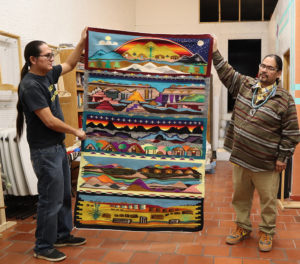
Weaving in Beauty

Explore the beauty and harmony of Navajo weaving

The Weaving News: Life in the Community of Navajo Weaving

April 16th 2010

New Online Class Sessions: The Teach High Touch with High Tech Adventure Continues

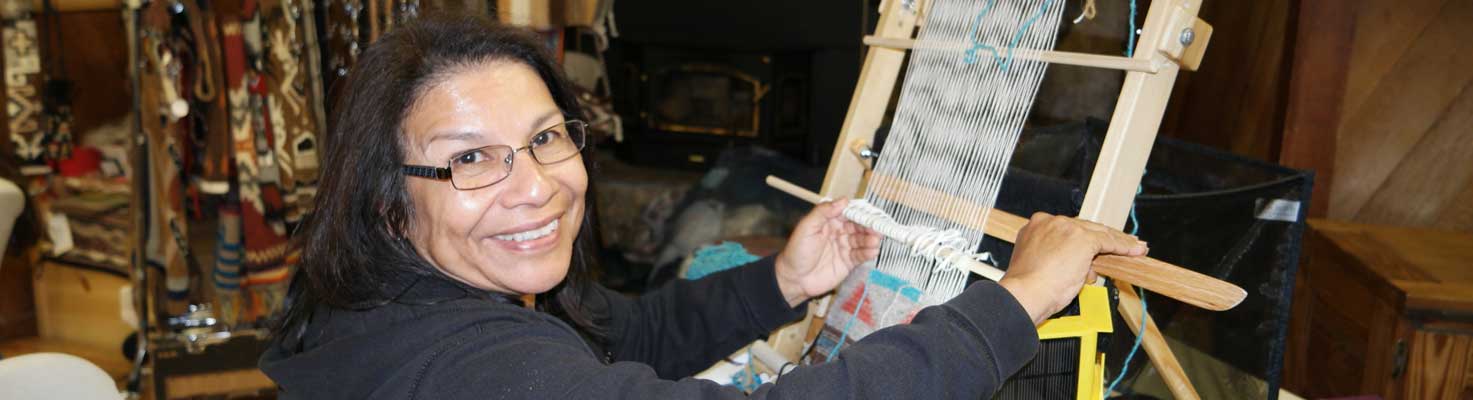
Tempe, AZ There are a lot of people stopping by here on a regular basis who are interested in learning to weave Navajo style.  Back in December, one of the more avid students and I engaged in some conjecture about whether it would be effective to do an online class, and we came to the conclusion that it was worth a try and would effectively help to use up any spare time that I was contemplating having.  I bought a subscription to WebEx, a new version of Adobe Acrobat and a really swell rolling computer stand.   I developed a syllabus that was roughly similar to what we do in a week in Window Rock and put the class on the site one Saturday morning at 8 AM.  I took off for the Fiber Factory to teach a class for them and by noon, the online class was full and I had an a lot of email from other prospective students who wanted to give the virtual class a try.    I was totally unprepared for that level of interest, but it was certainly better than getting a cosmic shrug!

The eight intrepid students, my writing partner Liz Munk and I started the class on January 31.  We originally planned five sessions, but we weren’t really tied to a particular timetable.  I tried to use streaming video to demonstrate the weaving and we quickly found that we had real problems with screen freezing assaults on bandwidth.  We also had to work through some severe audio feedback issues and I was really unsure that the format was one that would allow the students to learn effectively.   Still, the students were positively encouraging and we started working on some changes in the format that allowed students to access the video on demand and evolved a session agenda that blends a discussion and slide show of the technique being covered that week, a review of each student’s progress and work on solving problems and answering questions.

At the end of our session, everyone agreed that the class had helped them to succeed and progress on some level and so I’m pleased to announce a new session of the class as well as a private class option for those who can’t make the meeting time or who would prefer one on one attention.  The multi-student class will begin on May 16th with follow-on sessions on May 23, May 30, June 6 and June 20.   The two week gap will hopefully allow students enough time to get to the finishing point in their projects.  Students should expect to spend 1 1/2 to 2 hours in each session.  To limit issues with bandwidth, we’ll meet in two groups.  The early group will meet at 2:00 PM EDT, 1:00 PM CDT, 12:00 PM MDT, 11:00 AM PDT.  A second group will meet at 4:30 PM EDT, 3:30 PM CDT, 2:30 PM MDT and 1:30 PM PDT.  Each group will be limited to four people.   Students need to have access to a computer with a web cam, microphone and a high speed Internet connection.   The charge for the class is $75 and includes access to online materials and a private page on my web site for the duration of the class so that it’s easy to post pictures and communicate with me or other classmates.   You can register for the early class time  here and for the later time here (update: the later session is full).

The private class tuition is $125 and scheduling is subject to my textile conservation business requirements and other class commitments.   Got a friend who wants to learn with you?  You can register for a two student session at $100 each.   You should expect to spend two hours in the first session and one hour to 90 minutes in the following sessions.  Private students must complete their session within eight weeks unless my schedule does not permit it.  My generally available hours are 12:00 PM to 2:00 PM MST on weekdays, and 7:oo PM to 9:00 PM MST on Mondays, Wednesdays and Thursdays.  Saturday and Sunday scheduling is possible depending on other commitments that I have.  If you’re interested in doing this, please contact me before you register so that we’re sure that the scheduling will work.   If you can’t get in touch with me prior to registering, I’ll immediately refund your tuition if we can’t find a mutually agreeable time to meet.     I’m going to limit private student enrollment to four students or teams right now, with potential class sessions starting on May 11.  You can register here for a singe private student slot and here for a two student session.  If you want to participate in a two student session, it’s your responsibility to find and coordinate with the second student.  The course is geared toward five fingered carbon based life forms who live in the Cygnus Arm of this galaxy, but as long as your fellow student can meet the computer requirements, you’ll find I’m pretty flexible.

Please comment or contact me if you have questions!

Hagoshíí (so long for now)

Mary Walker

posted in Workshops | Comments Off
April 14th 2010

Keeping My Resolutions: Attend The Crownpoint Rug Auction

img_0977-1

Rena Robertson holds the latest in her Faces series of weavings. Here's she's done a Faces variation of the Storm Pattern

img_0982

Another Rena Robertson Faces rug.

Tempe, AZ One of my New Year’s resolutions is to attend the Crownpoint Rug Auction every month if at all possible.  So far, I’ve been able to make the trip and I’ve been rewarded by the opportunity to get to know some weavers better and to make new friends.  When I went to the auction in January, I was really impressed by a rug woven by Rena Robertson of Hardrock, AZ.  It was somewhat similar to the rug at right, another of Rena’s pieces that I purchased last month. The style is reminiscent of a now-rare pattern called a Hopi Figural rug, but Rena has updated the designs and colors and has integrated many elements significant in both the Navajo and Pueblo cultures.  The most striking elements are the serene stylized faces that drew me immediately to the weaving.  Although they are somewhat similar to both Ye’i and Katsina faces, Rena sees them as the faces of nature, animals, people and homes that are all around us, so the style might be called Faces of the World, or Faces of the Glittering World in honor of the Navajo view of this incarnation of the world that we live in.   I’m pleased to offer both of them in the Weavings for Sale section of the Mercantile.  The single Faces piece is sold but you can click here for another picture and more information.  The Storm Pattern Faces piece is priced at $595.  Click here for more details and the purchase link.

Rena’s friend, Lena Tahe had been bringing Rena’s work to Crownpoint, which is about 200 miles one way, but persuaded Rena to come this month and her husband, Martin Whitehair, who is also a weaver, accompanied her.   Martin is the brother of weaver William Whitehair Morris Muskett and I enjoyed discussing designs, weaving and silversmithing with Rena and Martin after the auction.

We also ran into Gilbert Begay, who had two of his popular bags with him, had being the key word here.  One is an over the shoulder 7″ square bag and the other is a clutch style that is 9 1/2″ x 6″ and is vegetally dyed.   Both have been sold, but please contact me if you’d like to order another one from Gilbert.

img_1016

Two Grey Hills (left) and vegetally dyed (right) bags by Gilbert Begay

I’m working on finishing up the book that I’ve been working on with Liz Munk and Jennie Slick, so I haven’t been posting as much as usual.  I think the book’s at a point where I can safely steal a little time to catch you up on some of the things that have been going on in my part of the Navajo weaving world.  Tomorrow I’ll be posting an update on our teaching high touch with high tech experiment and putting up the schedule for further online classes.

Hagoshíí (so long for now)

Mary Walker

April 7th 2010

Learn to Weave! May Weaving in Beauty Class Has An Opening, Natural Dye Retreat Update

Barbara Nicodemus

Put yourself in this picture starting on May 2!

Tempe, AZ One of the students scheduled to attend our May 2-9 class in Window Rock has had to cancel because of a serious illness in her family, leaving us with an open seat for the class.  This session is particularly good for people interested in the auction scene because it includes field trips to both the Crownpoint Rug Auction and the Friends of Hubbell Native American Arts Auction in addition to our regular weaving curriculum.  You can click here for more information on the class and you can click here to register online.  Please contact me if you have questions.

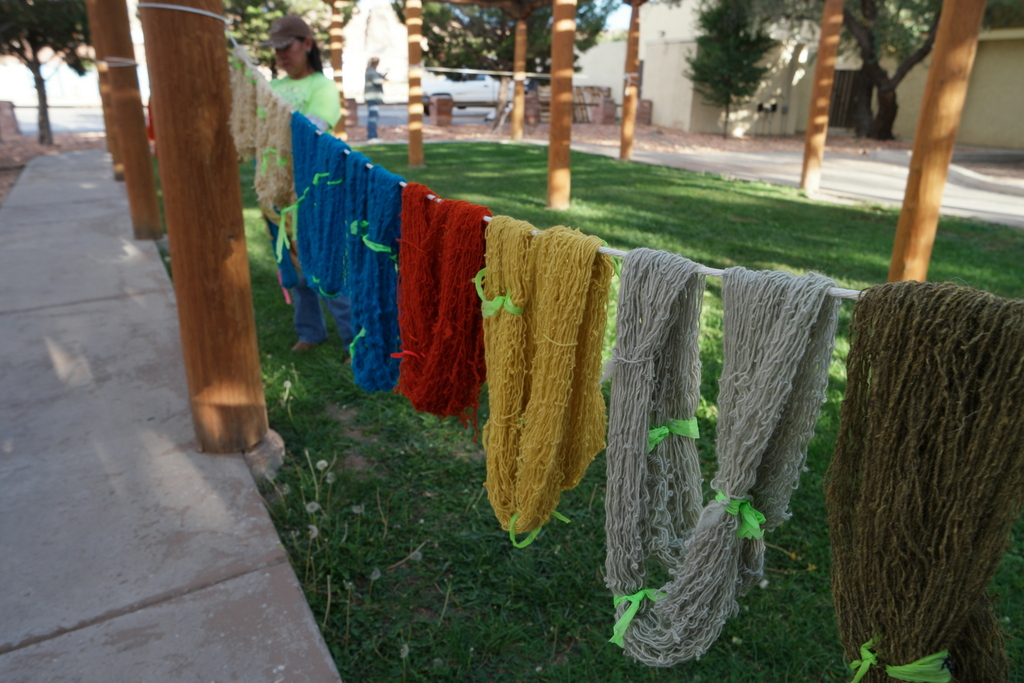
In other Weaving in Beauty class news, we have modified the Natural Dye Retreat to a one and half day format and reduced the price to $200 per student.  The change means that we concentrate exclusively on the dye work and don’t do any trading post field trips, but these can be done independently.  The retreat is scheduled for August 7-8 (7:30 AM Saturday- 1:00 PM on Sunday).  You can read more about the retreat here.  If you already know that you want to pay to dig holes, wash pots and eat smoke, you can register for the class here.  I love the small of cochineal in the morning.

Alyssa and cochineal

Spider Rock Girl Alyssa Malone with the results of the Cochineal Cook-off portion of last year's Dye Retreat

Hagoshíí (so long for now)

Mary Walker

posted in Workshops | Comments Off
March 16th 2010

Roy Kady to Show Work at Exhibit of Navajo Culture and Cuisine in Denver


Roy Kady will exhibit his work at the University of Denver, April 2-22, 2010. (Photo courtesy of University of Denver)


Denver, CO Navajo master weaver Roy Kady will show his work from April 2nd -22nd in an exhibit titled Na’ashjé’ii Biką’ Biyiin (Chant of the Male Spider). Roy is co-curating the exhibit with Teresa Montoya (Diné), a graduate student in the University of Denver’s Department of Anthropology.  Set within the context of Navajo weaving, Roy will share his personal stories, experiences, creative inspirations and work in an environment where visitors are invited to touch, smell and participate in the experience of weaving.

Roy is a truly engaging and inspirational person to meet and is generous in sharing his culture and work.  In the past, he has been a key participant in the Diné bé Iiná (Sheep is Life) organization and he is now the chapter president in his home community of Teec Nos Pos, Arizona.  The chapter is the basic unit of Navajo tribal government and is roughly analogous to a hybrid of town and county, with each chapter a distinct legal unit with the right to form binding contracts.  As if being the chapter president and an active weaver weren’t enough, Roy also cares for his large flock of sheep and goats.  You can learn more about Roy and his family at his beautiful and informative web site, Dinewoven.com.

The exhibit opens on April 2nd at Sturm Hall on the University of Denver campus and runs through the 22nd of April.  The opening reception on April 2nd, from 5:30-8:00 PM, will feature a weaving demonstration with Roy, a discussion of the religious aspects of the weaving process by Anderson Hoskie, and a sampling of foods based on the traditional Navajo diet prepared by chef Freddie Bitsoie.  Foods will include Churro lamb, blue corn puree, butternut squash tarts and Navajo tea.

Click here for further details on the exhibit from our events calendar.

Roy is looking forward to seeing both new and old friends in Denver and is busy working to finish a Guardians weaving similar to the one that he’s holding in the picture below from last year’s Heard Museum Indian Market.


img_4961.jpg

Roy Kady holds a Guardians weaving at the 2009 Heard Museum Indian Market.


Oh and one more thing!  Happy Birthday, Roy!

Hagoshíí (so long for now)

Mary Walker

posted in Shows and Events, Weavers and Their Stories | Comments Off
March 11th 2010

Heard Museum Indian Market Starts with Scottsdale ArtWalk

img_0438

Marie H. Yazzie (left) and her daughter Marilyn demonstrate weaving and spinning at the Scottsdale ArtWalk

Scottsdale, AZ The busy Heard Museum Indian Market weekend kicked off on Thursday, March 4, with the weekly ArtWalk giving special attention to the many Native American artists and craftsman who were in the Phoenix area for this large annual event.  Both artists and attendees travel thousands of miles to be at the market, so I felt very fortunate that it’s near my home.

Mark Winter, the trader at  Toadlena Trading Post, in Toadlena, New Mexico, had even rented a storefront on Scottsdale’s Main St. for the weekend and I enjoyed chatting with weaver Marie H. Yazzie and her daughter Marilyn, pictured above.  Marie does not speak English conversationally, so I got to practice a bit of Diné bizaad (the Navajo language).  Marie said I did pretty well for a bilagáana (white person).  At least I think that’s what she said.  Marie weaves handspun Two Grey Hills designs and also does round Sandpainting pieces as you can see in the picture below.  The larger rug is a depiction of Mother Earth and Father Sky, which has always been one of my favorite sandpainting images.

Round weavings by Marie H. Yazzie among other Two Grey Hills style work

I asked Mark how he was doing on his much anticipated Master Weavers book, the culmination of over 20 years of work with Two Grey Hills weavers and he told me that he expected to have it done by summer and possibly by May, in time for the opening of an exhibition at the Wheelwright Museum.  I’ll certainly keep you posted on that.   Jackson Clarke II of the Toh-Atin Gallery in Durango, Colorado stopped by as Mark and I were talking and I got a nice picture of both of them, which you’ll see below.

img_0449

Jackson Clarke (left) and Mark Winter (right)

I also stopped at the Old Territorial Shop and Turkey Mountain Traders during the evening, so we’ll stroll there next, but it might be Saturday or Sunday before we get there!

Hagoshíí (so long for now)

Mary Walker

March 4th 2010

Navajo Weaving Boot Camp Scheduled for June 13-16 at Bear Lake (Utah-Idaho)


img_0298

Jennie Slick assists Kathleen Higham with her weaving at last year's Bear Lake Boot Camp


Tempe, AZ Update: The workshop is full as of March 9, but please contact Mary Walker or Deby Pendleton if you would like to be on our waiting list.

I’m happy to announce that plans have been finalized for the fifth Navajo Weaving Boot Camp workshop at Bear Lake on the Utah-Idaho border.   We’ll be weaving at the Utah State University Training Facility starting on Sunday afternoon, June 13th and we’ll keep weaving as much as humanly possible until about noon on Wednesday, June 16th.  The workshop is open to students of any skill level.   Students will be provided with plans for building a loom or you can purchase one from the workshop organizers.   Use of tools is included in the workshop tuition and tools and yarns will be available for purchase.

Tuition for the three day workshop is $350 and includes dormitory style sleeping accommodations, three delicious meals per day featuring large quantities of raspberry based foods, enough yarn to complete your project, use of weaving tools and the instructional support of master weaver Jennie Slick and her assistant Mary Walker (me).  The workshop site is on the shore of Bear Lake, a gorgeously blue natural lake on the border of Utah and Idaho (please see unretouched photo below).    The workshop is limited to 12 students.


img_0308

Student looms at the 2009 Bear Lake Navajo Weaving Boot Camp.


See you at the lake!

Hagoshíí (so long for now)

Mary Walker

  • Slideshow

  • Get the Flash Player to see the slideshow.
  • Questions and Comments

  • Previous Next All
    Latest on Sun, 03:05 pm

    kathleen higham: I'd like to join with you when it starts again!

    Mary Walker: The Munsell color system was developed to provide a precise numeric description of color based on hue, value or lightness and color purity (referred to by Munsell as chroma). This precision is helpful in mixing dyes to achieve the desired results. There is a Munsell study group on Weavolution.com, but I was too busy teaching right now to join. I hope there will be enough people interested to do another group later this year. If you haven't already joined Weavolution, I'd encourage you to do it. The current study group is called the Munsell+dye study group.

    Emmy: I'm curious now. What is a Munsell group? Thanks Emmy

    » Please add your comment or question here